Free Images for everyone can be found here!!

Bloggers, you can use photographs from here for free, if your your blog is non-commercial. If a commercial website, the cost is nominal. All pictures on this blog are copyrighted to me. If an image is used, do attribute it as specified here! These photos are only for blogs/websites. If distributed, same conditions apply to end-user. Brick and mortar businesses have to pay (unless non-profit).Thanks.

The photos cannot be sold. For commercial purposes other than the web, pay as specified here. Select photos by using the SEARCH function under the Archives, found at the bottom of page (my email id is there too) or labels at bottom of each post. To see original image, click on image or ask me for a bigger and better one.


Showing posts with label Ajanta. Show all posts

Monday, January 28, 2013

Close ups of Ajanta's exteriors

These rock-cut caves near Aurangabad in India are a world heritage site and fairly well preserved. These 30 caves represent Buddhism. Although much of it has been eroded by the sands of time, it is worth a see. The  fact that they have been preserved since the fifth century B.C. is amazing. They lie inside a horseshoe shaped gorge, and a reason they were protected from the the harsh vagaries of nature. The caves are a fine example of ancient Buddhist architecture. These images show what the exteriors are like in general, and are just a sample. In actuality many of temples can be double storeyed and spread out over a large area.

An example of what the exterior of an Ajanta cave can look like.

beautiful sculptures at Ajanta in Aurangabad

Some type of Buddhist monastery at Ajanta.

Buddhist monastery at Ajanta Caves in Aurangabad, India

Amazing how the ancients managed to carve such a thing of beauty into the dark rock.

Buddhist art at Ajanta caves


A closer look at the sculpted exteriors of the Ajanta caves at Aurangabad.
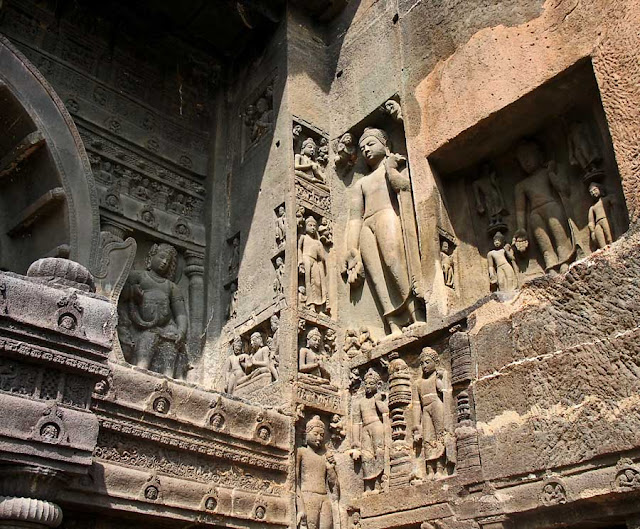
sculptures on exterior walls of Ajanta caves


Temples carved into the hard rock of the western ghats.


Related images: A View from Ajanta - scenery of rocks, caves and hills which is a panoramic view of the hills surrounding Ajanta caves. Or  see photos of Ajanta Caves exterior images which reveal the horseshoe shaped gorge and the temples carved into it. Or check out all the carvings, sculptures and paintings at Ajanta or Ellora, where you will find photographs of both the Ajanta and Ellora caves and the art.
Or try photos from these posts: Group of temples at Mahabalipuram or Mammallapuram or Shore Temple at Mahabalipuram or Mammallapuram or Meenakshi Temple or Tiru-alavai images
Or check out the scores of images filed under the label "Temples"

-->
-->

Wednesday, December 26, 2012

Inside the Ajanta Temples

The centuries old Ajanta Caves on the outskirts of Aurangabad are some of the most well maintained ancient archaeological world heritage sites in India. These 30 rock-cut caves are quite magnificent from the inside although the sculptures have chipped away and colours faded. The fact that they have been preserved since the fifth century B.C. is a miracle. One of the reasons could be that they are inside a horseshoe shaped gorge. The caves mainly represent Buddhism and are a great example of ancient Buddhist architecture. These images present a glimpse as to what the interiors are like and are just a sample. In actuality there are more than just 30 temples, because the temples often consist of several shrines and can be double storeyed.

In this picture you can see the large stone hall inside the temple. The pillars and ceiling is intricately decorated with sculptures. The Buddha can be seen inside the main shrine.

ajanta temple hall

Here is another temple hall which appears plain by contrast. However most of the artwork has simply been eroded away by time. On the pillars you can see the remnants of the coloured paintings. One can only imagine how spectacular the temple must have looked when it was just made.
ajanta temple hall with painted pillars

The inside of one of the main caves at Ajanta. The ceilings, walls and pillars are all elaborately sculptured and painted.
decorated temple cave at Ajanta in Aurangabad

A look at the inner sanctum where the figure of Buddha is kept.
Buddhist shrine at Ajanta

A passageway or corridor with Buddha sculptures at the side of the main hall.
temple corridor at Ajanta in Aurangabad


You might also like View from Ajanta - scenery of rocks, caves and hills which is a panoramic view of the hills surrounding Ajanta caves. Or you can check out Ajanta Caves exterior images which reveal the horseshoe shaped gorge and the temples carved into it.
Or see all the carvings, sculptures and paintings at Ajanta or Ellora, where you will find photographs of both the Ajanta and Ellora caves and the art or try any of the labels below this post which will take you to art from all over the world.

-->
-->

Monday, December 17, 2012

Ajanta Caves exterior images

This is what the Ajanta Caves look like from the outside. These 30 rock-cut caves are buried deep inside a horseshoe shaped gorge of the Waghora river. They represent the two distinct phases of Buddhism - the Hinayana phase from the second century BC to the first century AD and the second Mahayana phase from the fifth century AD to 6th century AD. They are a prime example of early Buddhist architecture and art. These caves remained safe from Mughal invaders as the caves were hidden deep in the rocks inside the jungles outside Aurangabad.

The caves stretch out into a long distance and Aurangabad is hot, so it is a long hot walk on concrete and stone. The caves are often double storeyed, if not higher, and that means climbing up and down for hours. Plus, the caves are huge inside with various halls and rooms and thus exploring some of the big caves can take over an hour. Chalk out a whole day for this adventure if you are serious about seeing this ancient art!

ajanta caves panorama

A closer view of the rock caves at Ajanta, on the outskirts of Aurangabad.

Ajanta Rock Caves at Aurangabad

This is the view when the camera was turned in the opposite direction.

Ajanta caves exterior

Another view of the Ajanta caves. The road to walk on is hard concrete and heats up. Decent and accessible toilet facilities were not available, at least not when we went. The toilet was locked!
horse shoe shaped Ajanta Caves

You might also like View from Ajanta - scenery of rocks, caves and hills which is a panoramic view of the hills surrounding Ajanta caves, through the mouth of the horseshoe.
Or check out all the carvings, sculptures and paintings at Ajanta or Ellora, where you will find photographs of both the Ajanta and Ellora caves and the art.


-->
-->

Wednesday, December 21, 2011

View from Ajanta - scenery of rocks, caves and hills

A beautiful scene which can make a good header for a blog of a view from the Ajanta rock cave temples. The Ajanta caves are hewn out of rock which is in the shape of a horse-shoe. This photograph is taken from the inner curve of the horse-shoe (shaped like a "C") and you can see the rock caves on both sides, curving around like the arms of a C. There is lush green vegetation, rocks, and a small stream.


view from the Ajanta caves


More headers: Headers or Nature Headers
Or check out the actual Ajanta rock temple caves here with their intricate carvings and sculptures: AJANTA

Thursday, June 16, 2011

Ajanta carvings sketches

Here are a few sketches and designs of the carvings found inside the ancient Ajanta Caves. These works were made from the 2nd century BC to the 5th century AD. These sketches are based on the photographs of Stone carvings and frescoes from Ajanta Caves.

Many of the designs are found on ornately decorated pillars, and the face here looks part animal and part human.
face on pillar sketch


Here are some pencil drawings of floral designs on Ajanta pillars.
floral designs on ajanta pillars


This sketch is one of the ornate entrances to one of the temples. The intricate designs on the slab above the pillars can be seen.
sketch of entrance to temple

This floral motif sketch depicts one of the designs from the pillars of the temples at Ajanta.
floral motif sketch from ajanta


See more posts on Ajanta, including the famous Ajanta Paintings. Check out the posts on the famous temples of Ellora.


Friday, June 10, 2011

Stone carvings and frescoes from Ajanta Caves

Here are a few examples of the carvings and designs found inside the centuries old ancient Ajanta Caves which are mostly Buddhist caves.  All the caves are filled with different type of frescoes, motifs, paintings and carvings. As these works were made from the 2nd century BC to the 5th century AD, time eroded the colours. The stone has also chipped in many places. Most of the photographs on this post are of carvings inside the caves and here flashlights are not allowed. Being fairly dark inside, it is difficult to get good photos. 

Many of the designs are found on ornately decorated pillars, like this one. The face here looks part animal and part human.

ajanta face

These floral type designs with tiny human figures were seen at the top of the pillar in one of the caves.
ajanta pillar design


These are primarily floral designs on a pillar at Ajanta. The greenish hue is because of the green artificial light shining on the pillar.
ajanta designs on pillars

Carvings are also found on the exterior and the entrances. This is the entrance to one of the bigger and better preserved caves. The colors on the exteriors of the caves has worn off. The intricate designs are interspersed with tiny animal and human figures.

ajanta carvings on exterior wall


See more posts on Ajanta, including the famous Ajanta Paintings and Ajanta sculptures and figurines. Check out the posts on the famous carved temples of Ellora.
--> -->

Wednesday, January 5, 2011

Buddha statues, frescoes and sculptures at Ajanta Caves

These are photographs of Buddha sculptures from the Ajanta Caves. These caves are cut out of sheer rock and belong to two distinct phases of Buddhism. The Hinayana phase from the second century BC to the first century AD and the Mahayana phase from the fifth to the sixth century AD. The paintings and sculptures in these ancient caves have been done during these periods. For a view of the paintings of Ajanta go to the links given at the bottom of this post.

While many ancient temples in India were destroyed by Mughal invaders, the Ajanta and Ellora caves survived due to their remote location.

The images of the sculptures of Buddha in this post are from different caves and not in any particular order. The first few images have more clarity as they were shot in daylight. Inside the lights are dim, and flashlights not permitted.

The first three pictures have been shot in the daylight. The sculptures are outside, on the exterior walls of the caves.


The next one is of Buddha with a consort. The stone has deteriorated due to the vagaries of time, but it's amazing that it has lasted so long! If you click on the picture you will see how porous the stone is now.

Buddha with consort

One can only imagine the original paint that once covered this stone depiction of Buddha.
Buddha figure on Ajanta wall


In this photograph the figure of Buddha is sitting in a lotus position inside an inner sanctum inside the cave. The golden light is due to the artificial light in the cave. All around the inner sanctum there are figures of Buddha carved into the stone.

buddha in the inner sanctum surrounded by small Buddhas

The next picture was one of the hardest pieces of art to capture as it was very dark inside the cave. One had to peer at the sculpture to see it. It was like clicking in the darkness. The photograph has been brightened to a large degree. The Buddha was in an inner sanctum deep inside the large cave, known as Cave No. 1. The bluish light is an artificial light casting its dull glow.
Buddha sculpture in Cave No.1


This huge eight feet long sculpture of the sleeping Buddha is a famous icon of Ajanta and lies in Cave 26.
Sleeping Buddha in Cave 26


This sitting Buddha was inside a large cave with much of the cave was in poor condition due to centuries of neglect. The once colourful murals on the wall are faded and worn.
Sitting Buddha in cave


The ever graceful and beautiful figures of Buddha can be seen in the photograph below.
Buddha figures inside cave

The picture below is a depicts the Buddha in a stone fresco. 
Buddha figure carved in stone fresco


The photo below is a part of a large fresco at Ajanta. The figure of Buddha can be seen to the left of the image.
Buddha in large fresco at Ajanta


The picture below is a breathtaking sculpture or fresco of Buddha surrounded by beautiful women. He is in a meditation pose.
Buddha surrounded by beautiful women


This is a Buddha fresco in one of the temples at Ajanta. The carvings are above the pillars and near the ceiling.
buddha fresco in temple

For a spectacular image of Buddha try this post: Golden Buddha Statue or for more images of Buddha: Sketches and drawings of Buddha or photos of Ajanta Temple Paintings and Murals from Cave 2 or photos of Paintings and Murals from Cave 1 of Ajanta or simply click on the label Ajanta for photographs of the Ajanta sculptures and rock temples.

For images from Ellora try these posts: Kailashnath Temple at Ellora or Ellora Temples sculpted exteriors or simply click on the label Ellora.

If you are looking for designs and art and sculpture from different parts of the world try the label "Art"

-->
-->

Sunday, December 26, 2010

Ajanta Temple Paintings and Murals from Cave 2

These are photographs of murals and paintings from Cave No. 2 of the Rock Caves of Ajanta, near Aurangabad, which are fairly well preserved. The style of Art is called Ajanta. Ajanta Art comprises of different styles from different periods of time, from the 2nd century BC to the 5th century AD. These paintings influenced Art in India for many centuries.

Decorative themes using both animals, plants and humans have been used.

The first image is of art on the ceiling at the entrance to the Cave. Engravings can be seen on the doorway.

ceiling mural ajanta


The depiction of Buddha is visible on the top of the doorway.
Ajanta Art on the doorway

Considering that in ancient times there were not paint brushes as such, and artists used just twigs and animal hair, or painted by hand, the results are quite brilliant!
Ajanta cave paintings


These last two pictures are a glimpse of a wall mural inside the cave. It was quite dark inside and a dim light was shining on the beautiful canvas on the wall.
Ajanta paintings inside cave

Ajanta mural inside cave


This is a painted pillar from the cave. Sculptured decoration at the top and bottom of the pillar are also visible. Remnants of blue paint can be seen on the flower design.
painted pillar ajanta

This last painting was lying in the office where restoration work was going on. Am not sure where it came from or whether it is original Ajanta or just a copy.
ajanta style painting

More images of Buddha: Golden Buddha Statue or photos of Buddha statues, frescoes and sculptures at Ajanta Caves or photos of Paintings and Murals from Cave 1 of Ajanta
For pencil drawings of Buddha: Sketches and drawings of Buddha or simply click on the label Ajanta.


For images from Ellora try these posts: Kailashnath Temple at Ellora or Ellora Temples sculpted exteriors or or simply click on the label Ellora.


Wednesday, December 15, 2010

Paintings and Murals from Cave 1 of Ajanta

These are photographs of murals and paintings from Cave No. 1 of the Rock Caves of Ajanta, near Aurangabad. Many modern designs, drawings and patterns are based on this ancient work, and the style is called Ajanta Art. Ajanta Art comprises of different styles from different periods of time, from the 2nd century BC to the 5th century AD. These paintings influenced Art in India for many centuries.

There are 31 caves cut out of rock, dating back to the second century BC. Cave 1 depicts scenes from the life of Buddha. There are sculptures and frescoes as well as paintings, but in this post I am showing mostly pictures of the ornate ceiling and wall murals.

These pictures are from Cave 1. Paintings from Cave 2 and also sculptures are in other posts, links to which are below this post.

This spot is a World Heritage site.

Ajanta wall and roof painting


These paintings are Buddhist in origin and narrate tales from the life of the Buddha and his teachings. They are found on the walls and on the ceiling of the caves. Naturally,  colors have faded and tourists are not allowed to use the flash. The lighting is also dim, to preserve the colours. Getting sharp photos were almost impossible with the camera I had, a Canon digital.


Ajanta wall painting

The bluish green is not a colour cast, but the actual light in the caves, and it has something to do with preserving the paintings. One can only imagine how breathtaking these caves must have been before they vanished from all human contact for hundreds of years.
Ajanta ceiling painting


Ajanta ceiling painting

Ajanta ceiling painting

Ajanta ceiling painting


The light in these caves is very dim, and the ancient ones had no electricity. How did they draw such intricate paintings on the walls and ceilings of the rock caves? Well, they found an ingenious way out. There are long narrow water canals on the floor of the caves, and these enhanced the limited light.
Close-up Ajanta wall painting

Ajanta ceiling painting

Close-up Buddha painting Ajanta wall

Ajanta porch painting and frescoes

Ajanta wall painting


Ajanta ceiling painting


These caves were tucked away deep in the jungle and that is why Mughal invaders did not find them. They remained, and are a feast for our eyes today. More information on this cave is given here.

For more images of Buddha try this post: Golden Buddha Statue  and for pencil drawings of Buddha: Sketches and drawings of Buddha

Other related images: Ajanta Temple Paintings and Murals from Cave 2 or check out the sculpted art of Ajanta here: Buddha statues, frescoes and sculptures at Ajanta Caves or simply click on the label Ajanta.

For images from Ellora try these posts: Kailashnath Temple at Ellora or Ellora Temples sculpted exteriors or simply click on the label Ellora.